Professor Moriarty: The World’s Most Mysterious Math Professor (and Villain!)

Last Updated on April 14, 2026
Picture it: London, the late 1800s. Fog so thick you could lose your hat in it, gas lamps flickering, and somewhere out there, a man with a mind sharper than a razor and a moral compass that points due south.
No, it’s not your uncle after three cups of eggnog, it’s Professor James Moriarty, the “Napoleon of Crime” and Sherlock Holmes’s ultimate headache.
Grab your deerstalker (or your coziest blanket), because we’re about to have a friendly, slightly irreverent chat about the man, the myth, the mathematical menace: Professor Moriarty.
Why Did Doyle Unleash Moriarty on the World?
Let’s be honest, Sir Arthur Conan Doyle was in a bit of a pickle. By the 1890s, he was churning out Sherlock Holmes stories faster than you can say “elementary,” but he was tired.
The public, however, was as insatiable as a toddler at a birthday party, but instead of cake, they wanted more Holmes.
Doyle wanted out, but how do you retire the world’s greatest detective?
Simple. You invent a villain so dastardly, so clever, that only he could believably take Holmes down.
Enter Professor Moriarty, stage left, with a dramatic swirl of his academic robes.
Doyle didn’t spend years building up this villain; he basically dropped Moriarty into the story like a surprise pop quiz, just to see if anyone was paying attention.
And boy, were they ever.
Moriarty’s Job Description
Moriarty isn’t your average bad guy. He’s not out there picking pockets or running off with the crown jewels himself.
No, he’s the spider at the center of a criminal web, pulling strings, making things happen, and probably writing a treatise on the binomial theorem in his spare time (because why not multitask?).
Moriarty doesn’t just break the law; he organizes it, streamlines it, and probably color-codes it in a spreadsheet.
He’s the mastermind who lets others get their hands dirty while he keeps his chalkboard squeaky clean.
And let’s not forget: he’s a professor. That’s right, the world’s most dangerous villain is also the guy who could help you with your math homework, assuming you’re okay with a little light extortion on the side.
Holmes and Moriarty: A Clash of Equals

The first encounter between Sherlock Holmes and Professor Moriarty is not a dramatic face-to-face meeting, but rather a gradual recognition.
Holmes, through his investigations, begins to notice a pattern of criminal activity in London that is too organized to be coincidental.
His deductions lead him to the existence of a mastermind operating behind the scenes – Professor Moriarty.
This realization marks the beginning of their adversarial relationship, with Holmes determined to expose and dismantle Moriarty’s criminal empire.
Moriarty, aware of Holmes’s growing threat, responds with equal determination. He is not merely a criminal; he is a strategist, orchestrating complex schemes while remaining almost invisible.
Holmes’s pursuit of justice threatens the stability of Moriarty’s operations, prompting the professor to take direct action against the detective.
Their conflict quickly escalates beyond a simple game of cat and mouse, becoming a calculated battle of intellect and will.
Both men recognize the other as their only true equal. Holmes confides to Watson that Moriarty is the only adversary who has ever truly challenged him, both mentally and strategically.
Moriarty, in turn, sees Holmes as the singular obstacle to his dominance and is willing to risk everything to eliminate him.
Their methods mirror each other: Holmes uses deduction and logic to unravel Moriarty’s plots, while Moriarty employs cunning and ruthlessness to counter Holmes’s advances.
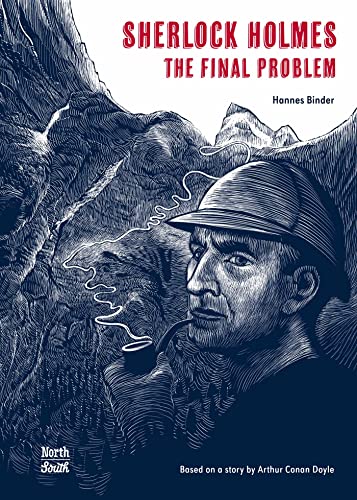
The struggle culminates in The Final Problem, where both men confront each other at the Reichenbach Falls.
Here, their rivalry reaches its peak with each determined to bring about the other’s downfall, fully aware that only one can survive.
Their final confrontation is not just physical but philosophical, representing a profound clash between justice and criminal genius.
In the end, both are willing to sacrifice themselves to ensure the defeat of their opponent, cementing their legacy as the ultimate adversaries.
It’s the literary equivalent of “if I’m going down, I’m taking you with me.”
Did Moriarty Actually Kill Holmes?
Sort of. In The Final Problem, Holmes and Moriarty have their epic face-off at the edge of the Reichenbach Falls in Switzerland.
After a struggle, both men tumble over the edge, presumably to their doom. Watson arrives too late and finds only signs of a scuffle and a farewell note.
For years, readers believed both men were dead. Doyle, for his part, was probably sipping tea and enjoying his newfound freedom until the public outcry reached fever pitch.
Eventually, Sir Arthur Conan Doyle caved, and ten years later, he brought Holmes back in “The Adventure of the Empty House,” revealing that the detective had faked his own death.
Moriarty, however, stayed dead, at least in the original stories.
Who Is Professor Moriarty, Anyway?

Professor James Moriarty stands as one of literature’s most enigmatic antagonists. Despite his profound impact on the Sherlock Holmes stories, very little concrete information is provided about his background.
What is known is that Moriarty was once a brilliant mathematics professor, renowned for his intellectual prowess and scholarly achievements.
Holmes describes him as a man of extraordinary mental acuity, whose academic work, such as his treatise on the binomial theorem, garnered significant respect within the scientific community.
Sir Arthur Conan Doyle deliberately left much of Moriarty’s personal history unexplored, enhancing the character’s sense of mystery and menace.
This vagueness has allowed later writers and adaptations to speculate about his origins, sometimes portraying him as a former government agent or attributing additional layers to his character.
However, in Doyle’s original works, Moriarty remains an elusive, almost mythic figure, more a symbol of pure intellect turned to criminal ends than a fully realized individual.
The choice of the surname “Moriarty” is also notable. It is of Irish origin, meaning “skilled navigator” or “sea warrior,” and may reflect Doyle’s own Irish heritage.
Some literary scholars suggest that real-life Irish figures influenced the creation of Moriarty, adding further depth to his ambiguous identity.
How Many Times Does Moriarty Actually Show Up?
Ready for a shocker? Despite his legendary status, Moriarty only appears directly in two of Doyle’s stories:
The Final Problem: His big moment.
The Valley of Fear: Key to the story, but doesn’t interact with anyone.
He’s referenced in five other stories, always as a shadowy presence, never center stage.
That’s it! Two appearances, five mentions, and yet he’s the villain everyone remembers.
The Cozy Mystery Angle: Why Do We Love Moriarty?
In the comforting world of cozy mysteries, where the stakes are rarely world-ending and the most pressing concern might be a missing scone or an unsolved village whodunit, the presence of a villain like Professor Moriarty adds a unique and compelling tension.
Moriarty is, in many ways, a blank canvas. Sir Arthur Conan Doyle gave readers just enough detail to spark curiosity while withholding the kind of backstory that might make him predictable or mundane.
What truly sets Moriarty apart, especially in the context of cozy mysteries, is the “what if?” he represents.
He is the living embodiment of the question: what if a mind as brilliant as Holmes’s had chosen a path of darkness rather than justice?
This contrast elevates the stakes of every encounter, suggesting that genius, when untethered from morality, can be as dangerous as it is dazzling.
Moriarty’s existence forces both Holmes and the reader to confront the fine line between good and evil, and to wonder how easily that line might be crossed.
Moreover, Moriarty serves as the perfect foil to Holmes. Without a nemesis of equal caliber, Holmes would simply be a clever detective solving puzzles.
With Moriarty, every investigation becomes a battle of wits, a test of character, and a genuine challenge.
In a genre where most antagonists are dispatched by the final chapter, Moriarty lingers in the imagination, a reminder that some threats are too complex, too clever, and too enduring to be so easily vanquished.
The Lasting Legacy of the “Napoleon of Crime”
Despite his limited page time, Moriarty’s influence is everywhere. He has inspired countless adaptations, from movies and TV shows to comics, video games, and puzzles.
Here’s a little snippet:
Movies
The Adventures of Sherlock Holmes (1939): George Zucco’s portrayal set an early standard for the cold, calculating Moriarty, pitting him directly against Basil Rathbone’s Holmes.
Sherlock Holmes: A Game of Shadows (2011): Jared Harris gave Moriarty a chilling, intellectual presence, engaging in a deadly chess match, both literal and metaphorical, with Robert Downey Jr.’s Holmes.
Enola Holmes 2 (2022): Sharon Duncan-Brewster offers a fresh take as Mira Troy (anagram), a female Moriarty who hides her identity behind a government secretary’s façade, bringing the character into the world of Holmes’s younger sister, Enola.
Television
Sherlock (2010–2017): Andrew Scott’s version is perhaps the most iconic modern Moriarty, depicted as a “consulting criminal” with a flair for psychological games and chaos. His rivalry with Benedict Cumberbatch’s Holmes is intense and deeply personal, culminating in memorable confrontations.
The Adventures of Sherlock Holmes (1984–1994): Eric Porter’s Moriarty, opposite Jeremy Brett’s Holmes, is lauded for its faithfulness to Conan Doyle’s stories and the believable chemistry between the arch-rivals.
Moriarty the Patriot (2020–2022): This anime series reimagines Moriarty as an antihero, exploring his motivations and giving him a more nuanced role as a social reformer in Victorian England.
Comics and Graphic Novels
The League of Extraordinary Gentlemen: Alan Moore’s comic series recasts Moriarty as both a criminal overlord and the head of British Intelligence, blending espionage and villainy in a richly imaginative alternate history.
Moriarty (by Daniel Corey): This comic book series explores what happens when Moriarty survives Holmes and must navigate a world without his greatest adversary, further cementing his mythic status.
Video Games
Sherlock Holmes: The Awakened (2007) & The Testament of Sherlock Holmes (2012): Moriarty appears as a formidable foe, his intellect and criminal reach challenging players to outwit him in intricate mysteries.
Moriarty: Endgame VR (2017): This virtual reality experience immerses players in a futuristic showdown between Holmes and an ageless Moriarty, demonstrating the character’s adaptability to new storytelling technologies.
Fate/Grand Order (2015): Moriarty is reimagined as a powerful “Archer” class servant, bringing his cunning to a fantasy setting and introducing him to a new audience.
Moriarty’s influence extends even further, and he is referenced or reimagined in everything from children’s cartoons (such as The Great Mouse Detective) to logic games; his name has become shorthand for the ultimate nemesis.
But maybe the real reason we can’t let go of Moriarty is that he represents the dark side of genius.
He’s what happens when brilliance isn’t balanced by conscience, when intellect is used not to build, but to destroy. He’s the ultimate cautionary tale and the ultimate adversary.
As long as there are stories to tell and mysteries to solve, Professor Moriarty will never truly disappear. And honestly, would we want him to?
Every hero needs a worthy foe, and every cozy mystery needs a little bit of shadow to make the light shine brighter.