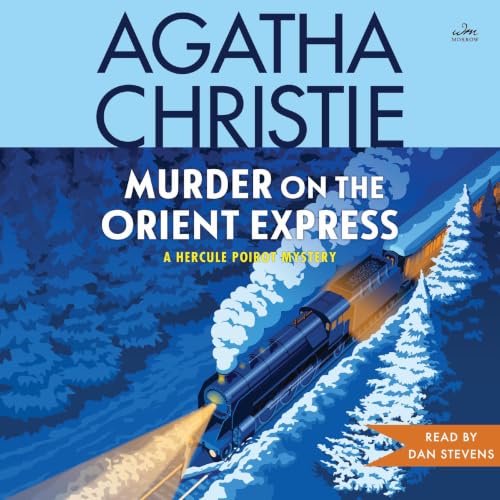
Murder on the Orient Express Explained – What is the Crime and How Does Poirot Solve It?

Last Updated on April 22, 2026
Agatha Christie’s classic detective novel Murder on the Orient Express has long been the go-to murder mystery novel since its publication in 1934.
The story follows the brilliant Belgian detective Hercule Poirot as he unravels a complex murder mystery aboard the luxurious Orient Express train.
Whether you’ve already read it or watched one of the numerous TV and movie adaptations, it’s easy to forget the exact intricacies of this famous whodunit.
So that’s what I plan to do today. Of course, that also means HUGE SPOILER ALERTS if you don’t already know the story.
I will tell you all about the characters, the crime, and the clever solution that has made it a cornerstone of mystery literature. Yes, that means I will tell you whodunit.
If you don’t want to know, stop reading and explore the rest of the Cozy Crime Mystery site, which will be just as entertaining!
The Setting and Characters
The story unfolds on the Orient Express, a long-distance passenger train service connecting Istanbul to Paris.
Trapped by a snowdrift, the train becomes an isolated crime scene with a limited pool of suspects.
At the center of the investigation is Hercule Poirot, Christie’s famous detective known for his “little grey cells” and methodical approach to solving crimes.
Joining him are an eclectic cast of characters, each with their own secrets and potential motives:
- Samuel Ratchett: An American businessman who becomes the victim of the crime
- Mrs Hubbard: A talkative American woman who claims someone entered her compartment during the night
- Princess Dragomiroff: An elderly Russian aristocrat with a commanding presence
- Count and Countess Andrenyi: A Hungarian diplomatic couple
- Greta Ohlsson: A Swedish missionary
- Mary Debenham: A reserved English governess
- Colonel Arbuthnot: A British Army officer
- Hector MacQueen: Ratchett’s secretary and translator
- Antonio Foscarelli: An Italian car salesman
- Cyrus Hardman: An American private detective
- Edward Masterman: Ratchett’s valet
- Hildegarde Schmidt: Princess Dragomiroff’s maid
- Pierre Michel: The French conductor of the Pullman car
As you can see from above, Agatha Christie created quite an eclectic mix of characters, so you have to follow the movements of at least 13 people to unravel the story.
So which amongst them ends up murdered, and who is responsible?
The Crime
The central crime in Murder on the Orient Express is the murder of Samuel Ratchett.
Poirot discovers that Ratchett was stabbed twelve times in his locked compartment during the night.
The varying force and angles of the wounds suggest multiple assailants, yet the locked door and undisturbed snow outside the window make this seem impossible.
As Poirot investigates, he uncovers a shocking truth: Ratchett is actually Cassetti, a notorious kidnapper responsible for a well-known and highly publicised crime years earlier.
Cassetti had kidnapped and murdered young Daisy Armstrong, leading to a series of tragic events, including the death of Daisy’s mother in childbirth and her father’s suicide.
Now that Poirot knows an entire family was devastated by his actions; he must figure out who on the train was related in some way to the Armstrongs enough to want to kill him.
The Clues
Agatha Christie masterfully weaves a tapestry of clues throughout the novel.
Some key pieces of evidence include:
- A handkerchief with the initial “H” found in Ratchett’s compartment
- A pipe cleaner and a match different from those used by Ratchett
- A button from a Wagon Lit conductor’s uniform
- A woman’s kimono spotted in the corridor
- A burnt note mentioning the Armstrong case
- Conflicting testimonies about timings and movements on the train
Out of context, none of these individual items means very much, however, when grouped together they start to tell their own story which is how Poirot pieces the puzzle together.
His investigation is a masterclass in deductive reasoning. He meticulously interviews each passenger, noting inconsistencies and curious details.
He examines physical evidence and reconstructs the timeline of events. As he pieces together the puzzle, Poirot realises that the seemingly disparate clues are too convenient, almost as if they were planted to mislead.
The Solution

In a dramatic reveal, Poirot presents two solutions to the assembled passengers. The first, a fabrication about a mysterious assassin boarding and leaving the train, serves as a cover for the truth.
The second solution is the startling reality: except for Poirot and two others, all the passengers were involved in Ratchett’s murder.
Poirot uncovers that every suspect had a connection to the Armstrong family. They had formed a jury of sorts, executing vigilante justice on Cassetti for his heinous crimes.
Each passenger had stabbed Ratchett once, explaining the varying force of the wounds.
The elaborate plot, with its planted clues and coordinated alibis, was designed to confuse investigators.
The Motive
The motive for the crime was revenge and justice for the Armstrong family.
Each of the passengers had been deeply affected by the tragedy in the following ways:
Mrs. Hubbard (Linda Arden) was Daisy Armstrong’s grandmother and mastermind of the plot.
Mary Debenham was Daisy Armstrong’s governess and Colonel Arbuthnot was friend of Daisy’s father.
Princess Dragomiroff was Godmother to Sonia Armstrong, Daisy’s mother and Count Andrenyi, husband of Helena Andrenyi, stabbed Ratchett on her behalf.
Countess Helena Andrenyi was Daisy Armstrong’s aunt, Cyrus Hardman was in love with Susanne, the Armstrong family’s nursemaid who committed suicide, and Greta Ohlsson was Daisy Armstrong’s nurse.
And so on it goes as each person was either related to, worked with or was particularly close to a member of the Armstrong family and/or the family nursemaid who also died.
Why Is The Ending So Famous?
Most cozy crime novels or murder mysteries are designed to provide the reader with a sense of justice. The bad guys get caught, the good guys save the day, and all is well in the world again.
In Murder on the Orient Express, Cassetti was obviously a character with no redeeming features. He had committed the worst of acts and gotten away with it.
The good guys ultimately decided to take matters into their own hands, which poses its own dilemma.
Are you really all that innocent if you yourself commit a crime, even if it was to avenge a worse crime? It’s that moral ambiguity that makes the book so fascinating.
Then we have Poirot’s struggle with whether to turn in the killers, which adds another layer of complexity and character development – both his and theirs.
In the end, Poirot did not turn any of the passengers into the police for killing Ratchett.
The clever part is that Poirot only proposed the solution as a theory. He then allows his friend, M. Bouc and Dr. Constantine, to decide which version to present to the police.
They choose to go with the first theory of the unknown assassin, effectively letting all the passengers go free.
Why Does He Let Them All Go Free?
Like most people, Poirot recognised that Ratchett/Cassetti had escaped justice for his awful crimes against the Armstrong family by way of legal technicalities and corruption.
This was undoubtedly a case where justice had not been served, and now, the 12 passengers, acting as a sort of jury, had decided on his fate.
All were motivated by deep trauma and grief and ultimately a moral justice had been served, even if it was outside the bounds of the legal system.
These people are not vigilantes; they just tried to right a terrible wrong, and Poirot chooses to prioritise them over their crime.
Incidentally, this decision has been debated by readers for decades, which is probably one of the main reasons that the book still continues to be one of the most popular despite being nearly a hundred years old.
The Movie Adaptation and Ingrid Bergman’s Role
The 1974 film adaptation, directed by Sidney Lumet, brought Christie’s intricate plot to the silver screen with an all-star cast.
Among the stellar ensemble was Ingrid Bergman, who portrayed Greta Ohlsson, the Swedish missionary.
Bergman’s performance, though brief, was powerful and memorable. She delivered a five-minute monologue that captured Greta’s fragility, determination, and inner turmoil.
This scene, shot in one long take, showcased Bergman’s exceptional acting skills and became a highlight of the film.
For her portrayal of Greta Ohlsson, Ingrid Bergman won the Academy Award for Best Supporting Actress at the 47th Academy Awards in 1975.
This marked Bergman’s third Oscar win, following her Best Actress wins for Gaslight (1944) and Anastasia (1956).
Bergman’s victory was not without controversy. In her acceptance speech, she praised fellow nominee Valentina Cortese’s performance in Day for Night, stating that Cortese deserved the award more.
This gracious act, while well-intentioned, inadvertently overshadowed the other nominees, something Bergman later regretted.
In addition to her Oscar, Bergman also won the BAFTA Award for Best Supporting Actress for her role, cementing her status as one of the most respected and versatile actresses of her generation.
This particular film also starred Albert Finney as Poirot, Lauren Bacall as Mrs. Harriet Hubbard and Sean Connery as Col. Arbuthnot.
The novel’s exploration of justice, morality, and the complexities of human nature continues to resonate with audiences, while its film adaptation, highlighted by performances like Bergman’s, ensures its place in cinematic history.