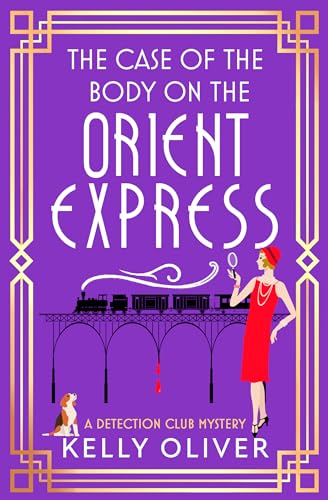
The Case of the Body on the Orient Express: All Aboard for Murder, Mystery, and Meta-Fiction

Last Updated on April 22, 2026
If you’re a fan of historical cozy mysteries with a dash of literary flair, Kelly Oliver’s The Case of the Body on the Orient Express is a delightful treat that you’ll want to hop aboard.
This is the second book in her Detection Club Series, and it’s set in the glamorous and intriguing year of 1928, a perfect backdrop for a mystery that combines real-life literary legends with a classic whodunit.
Christie & Sayers Take A Trip

Picture this: Agatha Christie and Dorothy L. Sayers, two of the golden age’s most celebrated crime writers, are boarding the legendary Orient Express, bound for Constantinople.
Christie is hoping for a break from her recent troubles, as her divorce from Archie and the lukewarm reception of her latest novel have left her feeling down.
But before she can settle into the luxury of the train’s first-class carriages, a fellow passenger drops dead during dinner.
And guess who finds herself the prime suspect? None other than Dorothy Sayers, who was the last person to speak to the victim.
Now, here’s where things get really interesting. While Christie and Sayers are the famous faces, the real detective work falls to Sayers’ assistant, Eliza, and her friend Theo.
These two amateur sleuths navigate a twisting maze of suspects as the train barrels eastward.
And just when you think the mystery might be contained to the train, another body turns up, complicating the investigation and raising the stakes.
The chase to find the killer before they reach Constantinople becomes a race against time, and the story expands beyond the train, giving readers a vivid glimpse of a city on the cusp of change nearly a century ago.
Eliza Is The Real Star

Eliza is not your typical sidekick; she’s the beating heart and sharp mind at the center of Kelly Oliver’s Detection Club Series.
Her story is one marked by resilience and determination. Having survived the devastating loss of her parents and the upheaval of war, Eliza emerges as a woman forged by hardship but never defined by it.
These early experiences have instilled in her a strength and self-reliance that set her apart in a world still reeling from the aftershocks of conflict.
When we meet Eliza, she’s serving as Dorothy Sayers’ assistant. But don’t let the job title fool you because Eliza is no mere note-taker or background character.
Her brief but impactful stint with the police before joining Sayers has left her with a keen investigative instinct and a knack for reading people and situations with startling accuracy.
This police work, though short-lived, gave her a taste for the chase and honed her natural curiosity into something sharper: a true detective’s intuition.
She’s smart, capable, and feisty, with a wit as quick as her mind. She doesn’t suffer fools gladly, and her no-nonsense attitude means she’s often the first to cut through red herrings and get to the heart of the matter.
In a genre where amateur sleuths can sometimes bumble their way to the truth, Eliza stands out as someone who gets things done, often outpacing even the more famous names around her.
Weaving Fact with Fiction
What makes The Case of the Body on the Orient Express especially fun is how Kelly Oliver weaves in historical fact with fiction. Christie and Sayers were indeed real-life acquaintances and members of the Detection Club, a society of mystery writers.
Oliver’s extensive research shines through, lending authenticity to the characters and their interactions. It’s meta-fiction at its best, where readers get to enjoy the thrill of a fictional mystery while appreciating the real historical connections behind it.
But don’t worry, the story isn’t weighed down by the famous names. Eliza, the assistant, is the real star here.
She’s resourceful, sharp, and a genuine pleasure to follow as she unravels the clues. Theo, her friend and partner in sleuthing, adds a bit of charm, though I must admit that his overly gushy declarations of love for Eliza can be a bit much at times.
There’s even a cheeky nod in the book about one author’s tendency to go overboard with flowery prose, so maybe Oliver intended Theo’s romantic verbosity to be a bit of an ironic joke.
Either way, it’s a minor quibble in an otherwise engaging narrative.
The Case of the Body on the Orient Express is well crafted, clear, and easy to follow without being simplistic. The pacing keeps you hooked, and the setting is richly detailed, transporting you to the golden age of crime writing and the exotic allure of Constantinople.
It’s a story that feels both familiar and fresh, perfect for readers who love cozy mysteries with a historical twist.
So, if you’re looking for a mystery novel that’s smart, entertaining, and sprinkled with literary history, The Case of the Body on the Orient Express is a solid choice.
You get the thrill of the chase, the charm of the 1920s, and the fun of seeing two legendary authors in a fictional adventure.
Overall, a thumbs up from me, and I think you’ll love it too.